All Releases / Documents
WikiLeaks releases 90 gigabytes of information relating to the German parliamentary inquiry into the surveillance activities of Germany’s foreign intelligence agency Bundesnachrichtendienst (BND) and its cooperation with the United States’ National Security Agency (NSA).
The 2,420 documents originate from various agencies of the German government including the BND and Federal Office for the Protection of the Constitution, Bundesamt für Verfassungsschutz (BfV) and were submitted to the inquiry last year in response to questions posed by the committee. They include administrative documents, correspondence, agreements and press reactions. They also include 125 documents from the BND, 33 from the BfVand 72 from the Federal Office for Information Security (BSI).
The collection offers a detailed insight, not just into the agencies themselves, but also into the mechanics of the inquiry. Several documents detail how the agency in question collated the information that was requested of them. For example, a BND document shows its preparations for collecting internal information on which private US companies are operating in the security sector in Germany. Such internal processes are particularly pertinent to the inquiry. The committee has been trying (unsuccessfully so far) to gain access to the full selector list that the BND holds regarding who they spy on at the behest of the US. The BND is withholding this list from the inquiry on the grounds that releasing it could imperil the BND’s relationship with the NSA.
Whilst a number of facts have already come to light as a result of the inquiry including WikiLeaks’ publication of inquiry transcripts last year this substantial new collection of primary source documents provides significant new evidence. The collection contains early agreements between the BND and the NSA and internal processes at the BND, but also more recent details on the close collaboration between the two agencies. For example, one document from the BND states that a BND employee will be tasked to use and write software for XKeyscore, an NSA system for searching and analysing data collected through mass surveillance.
A number of the documents show how intelligence agencies find ways to work around their own government. Documents pertaining to an audit visit by Germany’s data protection agency to the BND’s offices show that BND officers withheld the notes made by the auditors during their visit. The BND would only release the notes to the auditors once they had checked the content for themselves.
The inquiry was established in 2014 in the wake of the Snowden revelations, which showed that not only was the NSA spying on the whole world, but it had also partnered with the intelligence services of particular states to spy on their citizens and those of the surrounding regions. One of these countries is Germany, which has had a close relationship with the US in military and intelligence matters since its occupation by US forces in WWII. The US has been shown to use its bases in Germany and its relationship with German intelligence to spy on German citizens as well as European Union institutions.
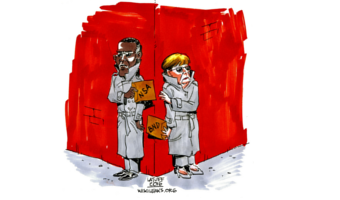
WikiLeaks revelations of NSA spying on Angela Merkel and top officials at German ministries, the EU and France also contributed to the political impetus of the inquiry.
The depth of this relationship had been unknown to the German public and much of its government. The outrage that was sparked by the Snowden NSA revelations led to the establishment of the inquiry, which later called for Mr Snowden to testify at it. Whereas there was initially unanimity among German political parties in 2014 for Snowden to provide expert testimony, the government deemed that guaranteeing that he would not be handed over to the US (a condition imposed by Snowden for testifying) would damage Germany’s political relationship with the United States. Subsequently, the Greens and the left-wing party (Die Linke) filed an official complaint to force the German Parliament to hear Mr Snowden.
Last week, on 21 November 2016, Germany’s Federal Court of Justice upheld the complaint and ruled that the committee was obliged to hear Edward Snowden in person. However, at the next inquiry hearing three days after the ruling, Chancellor Angela Merkel’s Union bloc and the Social Democrats removed Snowden’s invitation from the agenda of the inquiry and are contesting the Court’s decision.
Julian Assange said: “This substantial body of evidence proves that the inquiry has been using documents from Mr Snowden and yet it has been too cowardly to permit him to testify. Germany can not take a leadership role within the EU if it’s own parliamentary processes are subservient to the wishes of a non EU state.”